
Have you seen the movie Argo?
If you have seen the movie Argo, and are a pilot, you know how unrealistic the scene is with the fleeing airliner near the end of the movie. Though Hollywood pulls some highly impossible stunts, this one is really over the top in terms of how grossly impossible it is, and I’m sure I’m not the only one who noticed. If you fly you probably picked up on it right away. Cars chasing a 747 on the take-off roll? Right behind those engines which are operating at maximum thrust? They should be blasted into the taxiways.
Chasing a departing 747 in a Jeep is just a bad idea.

Jet scene from Argo. Image courtesy of ropeofsilicon.com
In a 747 aircraft, such as the one involved in the movie rescue has a take-off speed of about 155-160 knots (depending on load, field elevation, altimeter setting and temperature) – that’s 290 km/h and 184 miles/h. The first inaccuracy is that these cars are actually keeping up with the plane to the point it rotates. Old Jeeps in the 70’s keeping those speeds? Very interesting.
The second problem with this depiction is the creation of wing-tip vortices or wake turbulence. When a plane is accelerating down the runway, the engines are at full power, set for maximum thrust. As speed increases, air passes over the body of the aircraft faster and faster. Due to the cambered shape of the wing, the shape of the wing causes the air on top of the wing to travel faster than the air at the bottom of the wing. Because of Newton’s third law, the faster speed causes an area of low pressure at the top of the wing, and an area of higher pressure at the top of the wing. This causes lift.
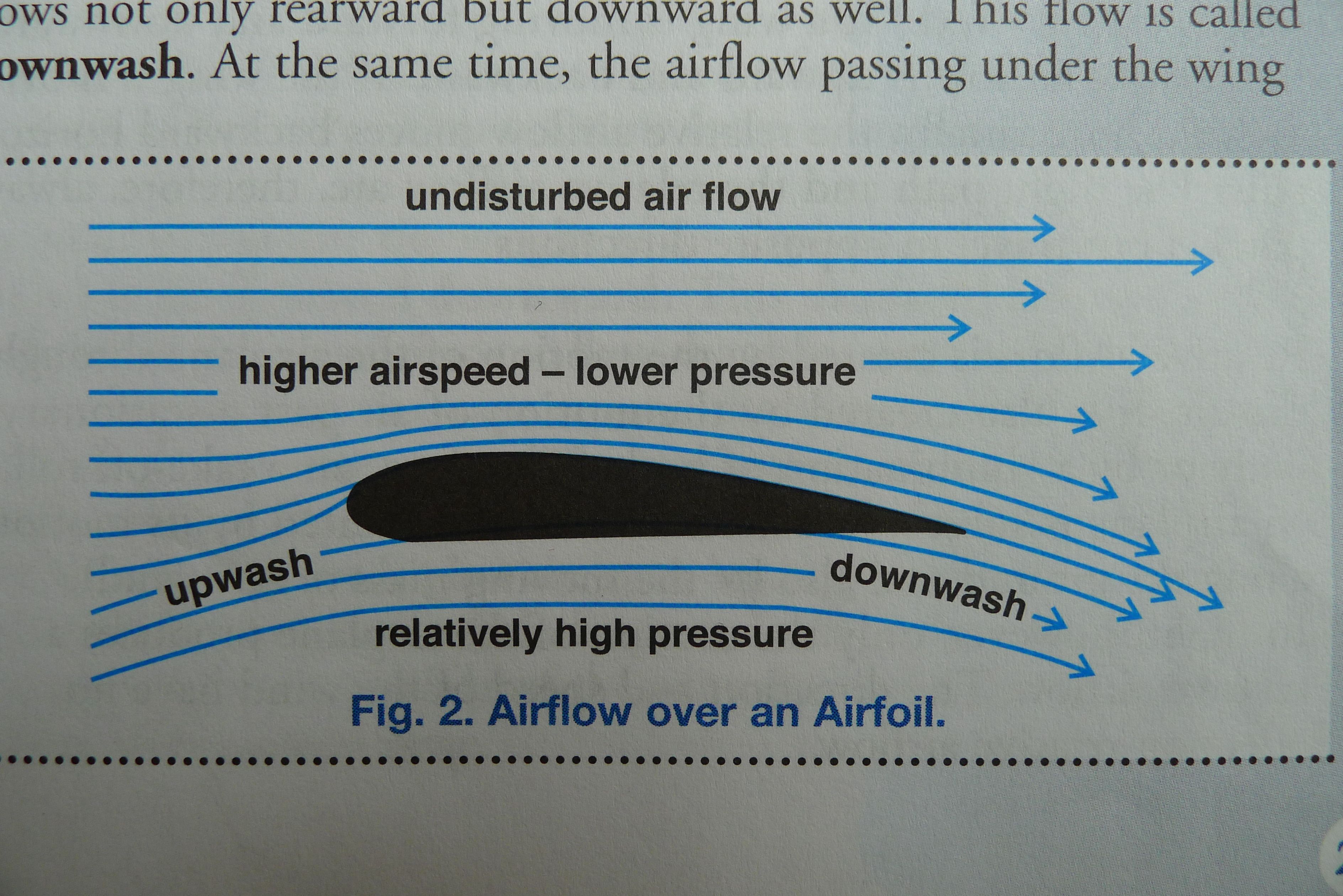
Airflow. Image from From the Ground Up, page 21.
Since the decreased pressure at the top of the wing is less than the atmospheric pressure around it, air over the top is deflected inward; air on the bottom of the wing is greater than the pressure of the air around it, hence it is deflected outward and curls upward over the wing tip.
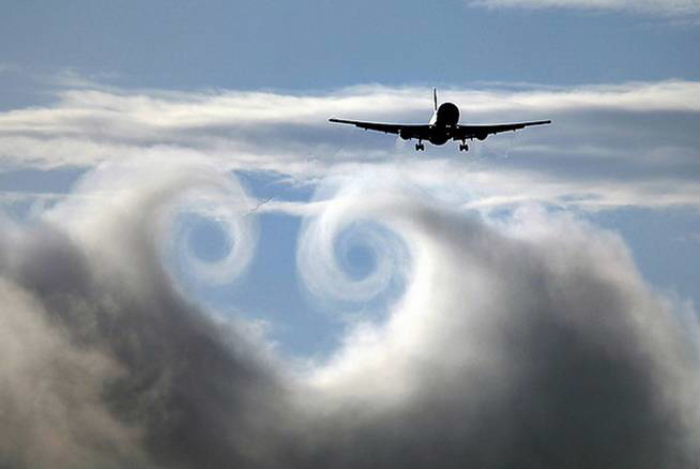
The two airflows unite at the trailing edge of the wing, creating eddies and vortices that unite into one large eddy at each wing tip, called wingtip vortices.
The heavier the airplane, the greater the span loading on the wing, the more air will be displaced downwards and the greater vortex will be generated. The vortex created from a Cessna 172 will be substantially smaller than one from a 747. Anything caught in the path of the vortex will tend to roll with that vortex.

Vortices are a by product of lift. Image from Nature.com
This is why many airplanes are now equipped with winglets – these tabs at the end of the wing actually prevent the two airflows from uniting, creating a barrier and preventing vortices from forming. Because vortices cause drag, preventing them from forming reduces drag and causes the airplane to use less fuel.
It is always very interesting to see how flying and airplanes are improperly depicted in movies for the sake of entertainment value. Something to think about.