
At Springbank airport, there are times of the year when there seems to always be wind shear when the wind is blowing from the west. This usually occours early in winter and winter. Here, storms and most of our weather comes from the west, as the lows roll in through BC as if on a conveyor belt. As the storms that form over the Pacific ocean meet the mountainous Vancouver Island and the BC mainland, the air starts to rise, creating thick cloud, depositing lots of snow. The air eventually descends as the mountains and then descends, compresses and warms up as it descends, and picks up significant speed, often 30 knots or more.
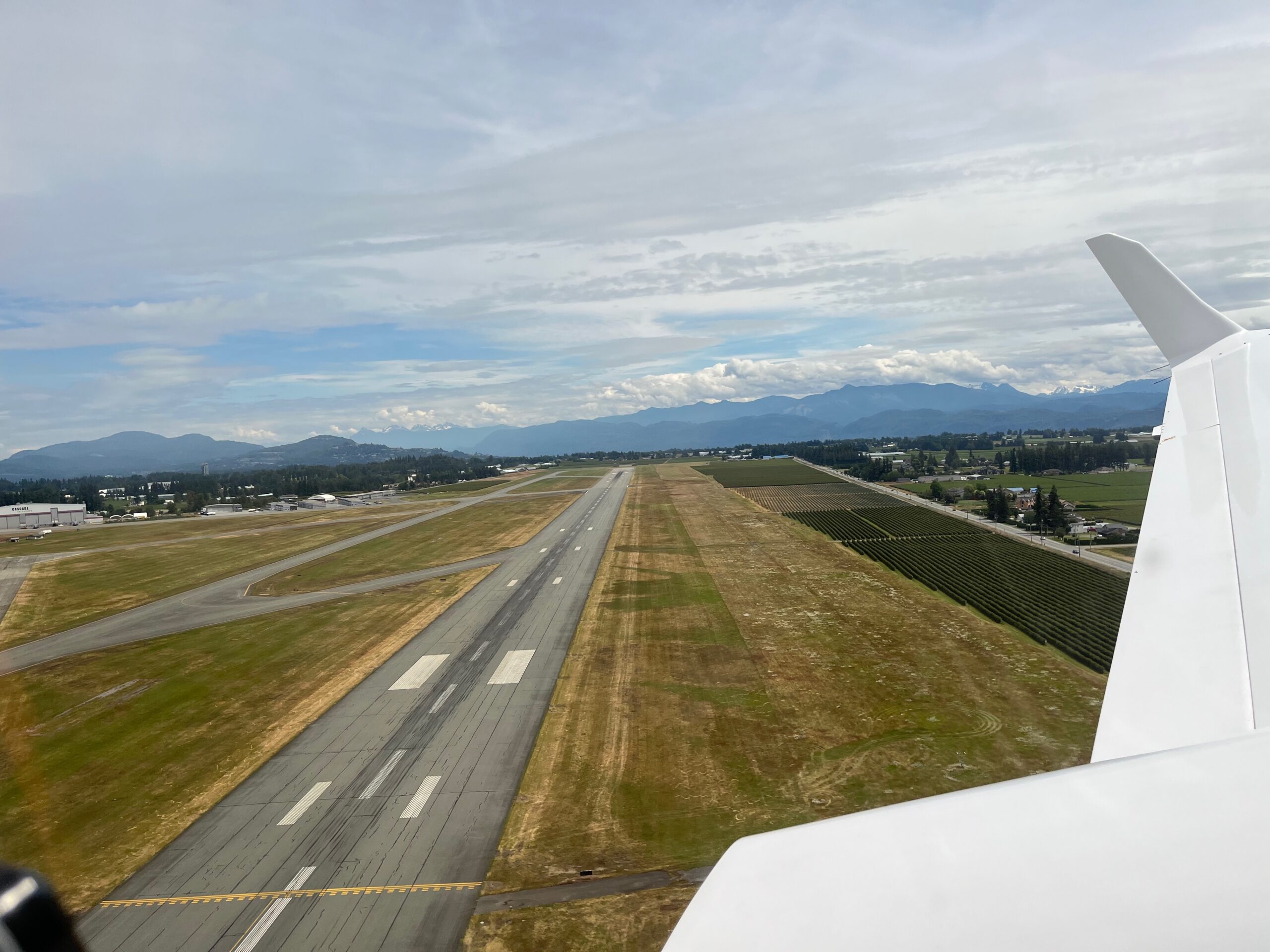
On runway 26, which is perfectly oriented during westerlies (often straight down the pipe!) we often experience quite a bit of wind shear and turbulence on our way on approach to this runway. On descent, the strong westerly will decrease and shift to a crosswind or tailwind for a few hundred feet, before shifting back into a headwind.

A good example of strong autumn winds at CYBW airport. Image from the Nav Canada website.
What is wind shear?
Wind shear is described as the change of wind speed or direction or both, in a short distance. This can happen at any altitude and be either vertical or horizontal.
Any time there is a decrease or increase in wind speed, it’s called wind shear. If direction changes, for example if a headwind turns into a tailwind, this is also known as wind shear. Typically, both will happen, the wind will change direction and strength, and you have to recognize it and manage it accordingly to stay on the proper glide path.
Wind shear can drastically affect speed and trajectory, and can be quite dangerous if it occours at a low altitude.
Increasing performance wind shear
In this scenario, we will get an increase in headwind – this is known as better performance, or increasing performance wind shear. It increases your speed (IAS) and lift and will have you climb above your intended glide path. As you approach, your intended touchdown spot will be further away because of your lower groundspeed. So more power will be required to reach this spot.
If this situation is encountered on short final, as it often occours at Springbank airport, and in some cases if an overshoot is not completed, your airplane can land long and fast and can in the worst case end up running out of runway.
Decreasing performance wind shear
This means a loss of headwind, or increase in tailwind. They both amount to the same effect. There will be a loss of IAS and loss of lift, and a descent below the intended glidepath.
Here, the intended touchdown spot will be closer because of your increased ground speed. To manage, reduce power to keep your approach stable. If this approach is left unmanaged, this can result in landing short of the runway.
Wind shear at Springbank airport
At certain times of year we experience wind shear on approach to runway 26 fairly regularly. Often, the wind will be very strong on approach and at some point, (could be around 300′-500′ AGL, but varying considerably), the airspeed will drop, indicating a loss of headwind. To manage the power we manage our attitude, so pitch down to maintain airspeed, but decrease power to keep on a stable approach.
At some point, the headwind will increase again (or tailwind will decrease) and you’re back to the regular headwind concept you started with. Keep an eye on the IAS and when you see it increase, reduce your power to stay on the proper glidepath.
Increasing tailwind at low level
Sometimes, the wind shear continues right to ground and never changes back. I had an especially dramatic experience with this while building night hours. Strong winds from the west continued through the approach until about 300′ AGL, where the consistent headwind abated and turned to a tailwind, which increased in intensity and continued almost right to ground. Unfortunately, my power management was not sufficient to maintain glidepath and my airplane kept getting pushed along and I got close to the runway, and then over it, much quicker than I expected. I expected the airplane to sink, but it never did, and before I knew it I was over the threshold to 26 with still almost 150′ of altitude, and not really in a stable descent.
The right thing to do there would be to overshoot, but through poor decision making I simply reduced power to idle, added full flap and put it into a forward slip. I barley touched down in time. I touched down by taxiway alpha and hit the brakes very hard. I realized how bad the decision was when I saw just how close the runway lights were when braking heavily. I made tower controllers sufficiently (and understandably) nervous and they told me “good job stopping” as I managed to stop the airplane just before I entered runway the end of the runway where 17/35 crosses.
I regret my decision not to overshoot as this type of reaction could have had very bad outcome. Right after witnessing my approach and landing, and other airplanes that had similar encounters on approach with the shifting wind, tower changed the runway to the opposite direction, from 26 to 08, as that was more appropriate for the prevalent wind direction.