


The high key and low key procedure is just one method of completing an engine out landing. It’s not the only method done when executing a forced approach, there are several others. This is the original one that I was taught and have used successfully to prepare for my flight tests. Obviously, the purpose is not just to pass your flight test but be prepared in case we do have an engine failure, which when flying single engine, is a real possibility.
This procedure is used to plan a forced approach in the event of an engine failure. We practice with idle power, remembering to use carb heat in a 172 with a carbureted engine.
When we have an engine out emergency, our goal is the extend our glide as far as we can. The longer we can glide, the more time we have to evaluate our landing options and plan an approach.
Establish the glide
Once we have established our glide and picked our field, we want to start turning into this field and planning an approach as fast as possible. This may mean we are turning towards our field when planning which way we are going to land, land into the wind if possible and avoid obstacles. We are also likely doing our engine restart checks as we do this turn. This is explained in detail in the forced landing article.
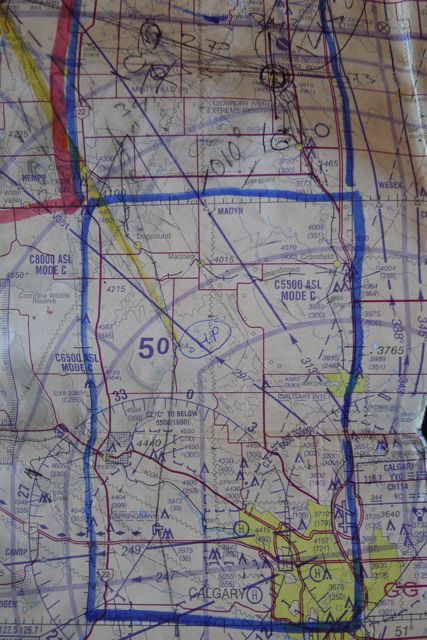
Calgary VFR Navigation Chart
We should note our altitude above ground level. This means we should note the altitude on our map. In the area where I am flying is near Cremona, Alberta, the elevation is around 4000 feet. When I start the procedure, I am at 6000 feet. I have 2000 feet of altitude to plan my approach and landing. Of course this is just a simulation, so when I am up with my instructor we do get within a few hundred feet of the ground, but when practice on my own I don’t go below 500 feet above ground, which is 4500 feet.
Start the high key
The procedure calls to start the high key abeam the threshold where we have chosen our landing spot. The altitude we should be above this threshold is calculated from whatever gives us a two-minute turn to our left in our aircraft and our rate of descent. The turn and bank coordinator and vertical speed indicator gives us this information.
Always plan your landing spot into the wind.
Plan your descent
In the Cessna 172, the two-minute turn gives us approximately 700 feet of altitude per minute. This means in two minutes we can descend 1400 feet if we use the information supplied in the turn coordinator for a two-minute turn. The FTM suggests that we use this altitude plus 200 feet of “fudge factor” to plan our altitude, meaning that we should be at 1400 + 200 = 1600 feet above ground at our “high key” position. Where I am flying, I am planning to be at the high key at 5600 feet.
This gives me about 400 feet to reach my high key position when I am flying at 6000 feet.
The low key position will be halfway around the turn, about a minute after entering the high key turn. My altitude should be 800 feet above ground or around 4800 feet ASL on my altimeter.
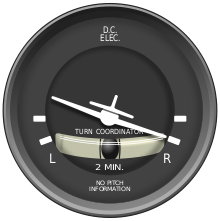
A two-minute turn shown on the Turn coordinator. Image courtesy of wikipedia.org
A good trick is to pick a landmark where you estimate will be your low key position. Look to your left when you are starting your high key. Is there a landmark that is approximately 1.5 miles from your high key spot? You should aim to be over that spot in your low key, and this will give you an indication whether or not you are in the proper spot in your sequence.
The final key
Our “final key” will be around 500 feet. Next we are at short final where we can decide if we are too high – and hopefully we are not too low!
Some things to note:
Winds
Be careful of the winds, these can affect your pattern and blow you off course. Also if you think that you are way too high, do a turning slip to loose altitude before adding flaps. This will allow you to loose more altitude. Remember, it is always better to be too high than too low. There are ways to loose altitude – such as a slip or using flaps – but there are no ways to gain it when we have no power. Also, the reason we turn left is because we are in the left seat we have better visibility of our landing spot on the left hand side.
The high key – low key landing procedure is only one way of planning the approach. It may sometimes be that we don’t need to do the key procedure, and can just do a series of turns to bleed off altitude, fly a “bow-tie” patten, or whatever system we think is best to get us on the intended landing spot safely. This means landing into the wind when possible, avoiding obstacles, and picking as smooth of a surface as possible.
This procedure is very difficult to do even when we are planning to do it in a simulation! I can imagine that when really loose engine power the situation becomes very real very fast, and coupled with the stress of knowing you have to put your plane in a field is very intense. This is why practicing the procedure again and again is so important: your response is automatic and you know what steps you need to go through in a real engine-out emergency.
Updated September 2025



Thank you so much for this very important information. I am student pilot.
This is why I love this website so much, filled with loads of info
Thanks for the feedback Patrick! I’m glad you find it useful.