
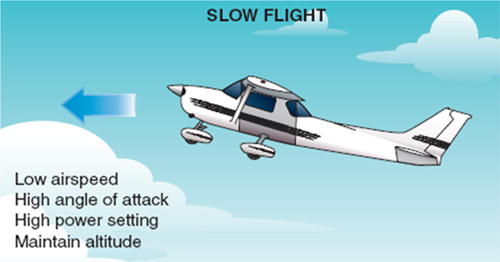

Why do we need to learn slow flight?
Because we are really close slow flight whenever we are landing and taking off, and we need to know how the airplane “feels” to operate at such low speeds. We don’t want to be in slow flight during these phases, so we want to know how to avoid it. Also, we pass through slow flight on our way to a stall, so we need to recognize when our airplane is losing enough airspeed and approaching a stall.
To enter slow flight for a Cessna 172:
1) Complete the HALT check. Each school has it’s own acronym or procedure for this check, but they are basically the same:
H = Height. Must be recovered by 2000′ AGL
A = Area. Not over a built-up, or civilized area. No buildings, homes, people.
L = Landing Checklist
T = Turn Checks. We do a 30 degree angle of bank turn in each direction 90 degrees. This is how we check for traffic in the area.
2) Reduce RPM to 1500 – Carb Heat Hot. Note the nose will drop.
3) Maintain altitude and heading. Pull up to prevent the aircraft from descending.
4) Add power to hold altitude.
Confirm Slow Flight. The following are five signs that alert us that we are in slow flight:
1. Stall Horn cutting in and out;
2. Low Airspeed
3. High RPM
4. High nose attitude
5. Sloppy aileron control.
We are in slow flight!

Related Posts
 How Wind Shear affects Airplane performance
How Wind Shear affects Airplane performance
At Springbank airport, there are times of the year when there seems to always be…

Alicja GadosSeptember 22, 2025
 The power off 180 accuracy approach and landing procedure
The power off 180 accuracy approach and landing procedure
The forced approach procedure is first learned when training for the private license, and is…
Alicja GadosSeptember 5, 2025
 What is IFR and how to get your IFR rating
What is IFR and how to get your IFR rating
If you're planning on becoming a professional pilot, you've already thought completing an instrument rating.…
Alicja GadosAugust 12, 2025