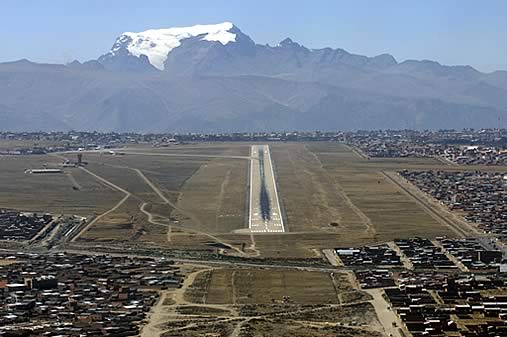

I read a post recently asking what is the highest altitude airport you have landed in. This reminded me when I flew into La Paz, Bolivia, landing at El Alto International Airport while on a backpacking trip in South America. It was aboard a Lan Peru Airlines Airbus A319. Though I wasn’t doing my pilot’s license back then, I was already very interested in flying, and did my research about this airport, knowing it was 4061 meters, or 13,325 feet above sea level. If I wasn’t a climber that would have broken an altitude record for me just landing at an airport that high!

Cessna Citation XLS in Tibet, the world’s highest commercial airport. Image courtesy of flightglobal.com
In order to land at El Alto, an aircraft must be equipped with special tires in order to be able to handle to high take off and landing speeds. Only certain airlines provide service to this airport as the aircraft must be modified.
How else does high altitude affect airplanes? Well recall that the higher up we go, the lower the pressure. Hence higher up the air becomes “thinner” and is less dense. Denser air results in better aircraft performance. In fact the four worst possible take-off and climb performance are when the following factors are combined:
1) Air Temperature is high (above 15 degrees C)
2) Airport elevation is high
3) Atmospheric pressure is low (below 29.92 inches of Mercury)
4) Relative humidity is high.
So why the long runways at these airports? El Alto has a runway that is 4 km long. This is because due to the low pressure that exists at this extreme elevation there is reduced air resistance. It is harder for the aircraft to slow down, and takes more time. The descent into this airport was noticeably short – the massive mountains looming on each side of the plane, and then before we knew it, the plane was close to the ground, which what felt like a disconcertingly high airspeed. It took a very long time to stop!
Since the highest altitudes on earth are mountainous, it is no surprise that these high altitude airports are surrounded by some pretty massive peaks. In Bolivia, among many other high mountains, Mount Illimani is in the area and looms over La Paz at 6438 meters (21,122 feet). These mountains create obstacles that need to be cleared. Though they are far away, we learn obstacle clearance on take-off and landing for this reason.