Following up on the previous article on air law, let’s review some details about Canadian airspace.
Air law is such a big topic and is very hard to cover in it’s entirety, so if you want more detail or more material refer to From the Ground Up and Canadian Aviation Regulations, the Canadian Aeronatical Information Manual.
Canadian Domestic Airspace is divided into seven classification, each identified by a single letter. The rules governing each airspace depend on it’s classification and not by which name the airspace is commonly known. Control l or terminal areas can be classified B, C, D or E but weather minimums for flying are still related to the common name of the controlled or uncontrolled airspace.
The classification, as you may remember from ground school, looks sort of like an upside down layer cake, where the smallest classifications are nearer the ground and larger zones extend upward.
Class A
This is all controlled high level airspace, only IFR flight is permitted. It spans from FL180 to FL600, inclusive. ATC (air traffic control) is provided to all aircraft, and require clearance to enter.

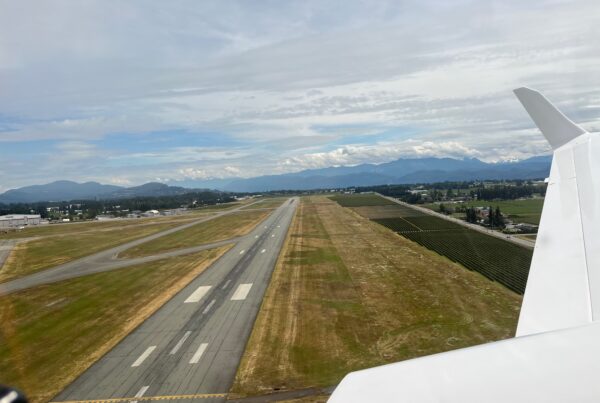
Tower at YBW. Contol zones can be class B, C, D or E.
In class B airspace, IFR and VFR traffic is allowed. ATC is provided. It includes all controlled low-level airspace between 12,500 and up to, but not including 18,000. VFR traffic must file a flight plan and request a route to enter. A pressure altimeter is required (has to have been certified within 24 months) and a transponder with mode C capability.
Class C
IFR and VFR permitted. VFR must be cleared by ATC to enter. Terminal control areas and associated control zones may be classified Class C when the appropriate ATC unit is not in operation. A 2 way radio and transponder with mode C capability is required. In case of a communications failure, squawk 7600. Otherwise, VFR traffic must use 1200 on transponder.
Class D
Both IFR and VFR traffic are permitted, and VFR must establish radio communications with ATC. ATC separation is only provided to IFR traffic. Terminal control zones can be classified Class D, and if there is no ATC they will revert to Class E.
Class E
This class of airspace exists when none of the requirements for neither A, B, C, D are met. Both IFR and VFR are permitted but again, ATC separation is only provided to IFR traffic. There are no special requirements for VFR traffic. Low level airways, control area extensions, transition zones and control zones without an operating tower may fall into this category.
Class F
Forbidden or advisory airspace.
Class G
Does not fit into any of the other airspace categories, and ATC has neither the responsability nor obligation to manage traffic. This is uncontrolled airspace. Low level air routes and aerodrome traffic zones fall into this category.
It’s easy to forget these classifications. A useful mnemonic to remember these types of airspace and what is associated with each will help you remember!
A = Airliners. IFR only. Between 18,000 and 60,000 feet.
B= IFR. Between 12,500 and 18,000
C = Clearance required to enter
D = Dialogue is required. Do not enter before talking to a controller.
E = Easy for VFR, Everyone gets home from this class of airspace, no need to talk to controllers.
F = Forbidden, or Fancy – special use airspace.
G = General uncontrolled airspace.
And of course, the U.S. has their own unique system of classification. Information on the U.S. system can be found in From the Ground Up.