I talked with my instructor last night and he brought up a few very good points about slow flight.
In my post about slow flight in the Cessna 172 I wrote that there are five signs that we can identify we are in slow flight;

  1. Stall horn cutting in and out
  2. low airspeed
  3. high nose attitude
  4. high power settings
  5. sloppy aileron control

But we can extend these concepts to some of the other flight surfaces.  What happens to the rudder and elevator? We know that because of a nose high attitude we are pushing the boundary layer of laminar and turbulent airflow further up the wings – hence the wings receive less smooth, laminar airflow and are subject to buffeting from the turbulent air.  This renders the ailerons sluggish and slow.
But how does this effect the tail of the aircraft?

Torque and Asymmetric Thrust
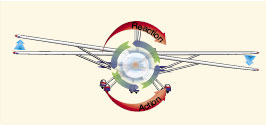
Torque causes left turning tendency. Image Courtesy of flightlearnings.com

Torque causes left turning tendency. Image Courtesy of flightlearnings.com

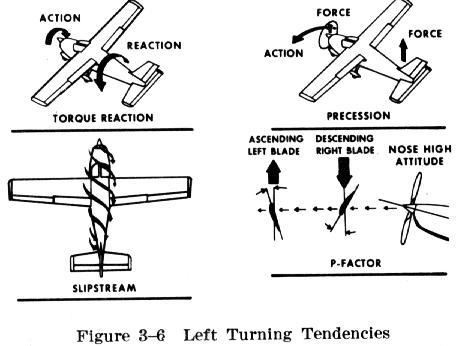
Recall that because of torque the aircraft wants to spin counterclockwise. This is because the propeller spins clockwise (when we are in the cockpit) and the airplane is a gyroscope – this tendency is explained by Newton’s third law.  Most aircraft are designed in a way to anticipate this, so in level flight, for example, many are designed to give more lift to the wing that is being forced downward. Torque means that the plane has a left turning tendency because more force is applied to left wing than the other. But this is only for level flight. When the aircraft is out of level flight, such as a take-off attitude or nose high attitude that we experience in slow flight, the aircraft will want to turn to the left. Hence, this is another effect on controls of slow flight.
Asymmetric thrust also means that the descending blade has a greater angle of attack than the ascending blade.  This gives more lift to the right side of the propeller (as seen from the pilots perspective) and a yaw to the left.  This happens during high power settings and in high angles of attack – just like in slow flight.  In level flight, both propeller blades meet the relative airflow equally (again, the thrust issue is anticipated in the design of the propeller) and they produce equal thrust, and no left yaw.
In addition, we also talked about why we need to learn slow flight. We are not actually in slow flight on approach and takeoff, but we are very close. We do not want to be in slow flight during these maneuvers, and want to be able to recognize when we are in too close. The airplane is no fun in slow flight – the ailerons are sluggish, the nose is high so our visibility is restricted, the engine is at high power settings and very loud. So the whole point of learning about slow flight is to avoid it.  It is not a comfortable flying experience.  Yesterday I learned how to do a slow flight with almost full power settings and full flaps. It was awkward flying it in this configuration.
So, another way we know we are in slow flight is due to (6) left yaw tendencies requiring use of right rudder to correct. This will be the sixth way we can identify we are in slow flight.

Alicja Gados

I was born in Europe (Poland) and moved to Calgary as a young kid and grew up in Canada. I began graduate school in Edmonton, Alberta where I also began ground school and my private pilot’s license training at Edmonton city centre, the now closed, Blatchford field, CYXD (most operators have moved a short way west to Villeneuve). I moved to the rocky mountains, I transferred flight schools to very busy, and windy Springbank airport – CYBW near Calgary. This move was overwhelming, at best. This is a blog about my experience learning to fly, acquiring more flight experience and ratings but also about general aviation topics, news and gear reviews. I’ve discovered that flying takes a lot of studying, work and dedication, but is very rewarding! I started flying just out of graduate school, so I have struggled with paying for my lessons, and as a result, I have to take many breaks, which means that getting licensed has taken many more hours than normal. I am a commercial and multi IFR rated licensed pilot. I completed my PPL and CPL in Calgary-Springbank and multi IFR (group one) ratings in Abbotsford, BC at Chinook Helicopters. If you are learning to fly, interested in learning to fly or just interested in aviation, please join us. I trained as an economist before becoming a pilot and switching to aviation full time. I enjoy climbing, mountaineering, hiking, camping and backcountry skiing. It’s a great time to be in aviation. The industry is growing.

One Comment

Leave a Reply